
Stairlift vs Home Elevator vs Platform Lift is a comparison that comes down to three key factors: your mobility needs, your budget, and how much of your home you’re willing to remodel. This guide breaks down all three residential lift options with real cost figures, installation realities, and honest trade-offs so Loganville homeowners can make a confident decision.
Three Home Lift Options: Which Solves Your Staircase Problem
Multi-story homes are wonderful until the stairs become the enemy. For Loganville homeowners focused on aging in place, that shift can happen gradually or all at once. Either way, there are three proven accessibility solutions worth understanding before calling a contractor.
A stairlift attaches a motorized chair to a rail on your existing staircase. A vertical platform lift (VPL) moves wheelchairs and mobility aids between levels without a dedicated shaft. A home elevator is a full residential vertical transportation system, built to last decades. Each solves a different version of the same problem. The right fit depends on who’s using it, how much space you have, and what you’re willing to spend.
Stairlifts: Fast, Affordable, and Ready in Days
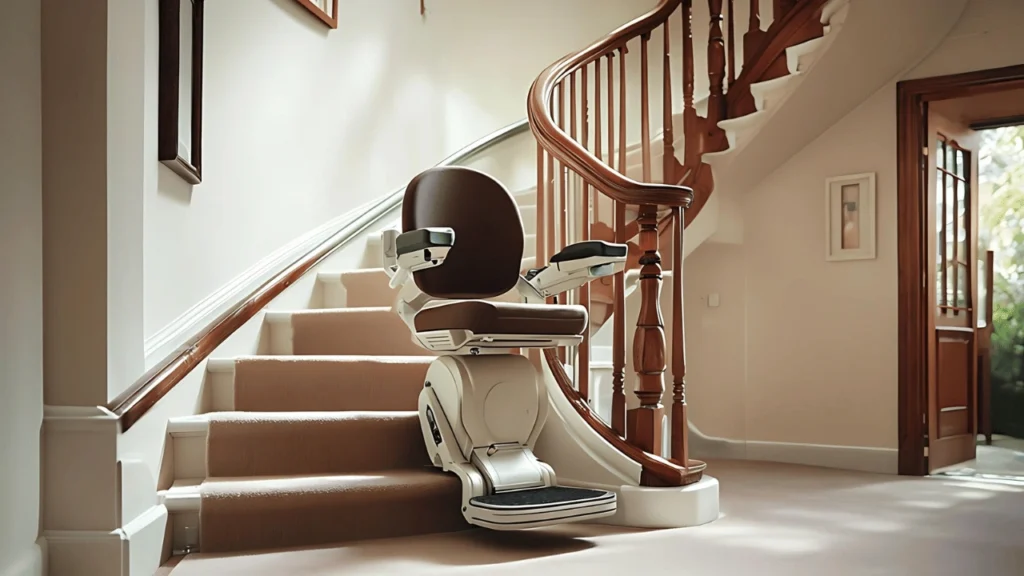
A stairlift home elevator comparison almost always starts here, because stairlifts are the entry point for most families. According to Harmar, a stairlift consists of a motorized chair that travels on a rail bolted to the stairs. It’s designed for people who can walk but struggle with the physical effort of climbing.
Installation is fast. Most stairlifts go in within a single day, with minimal structural modifications to the home. That’s a big deal if you need a solution quickly or don’t want weeks of construction disruption.
Cost-wise, the NCOA reports that stairlift costs typically range between $2,000 and $10,000, including installation and maintenance. For a straight staircase with standard features, expect to land somewhere in the $3,000-$5,000 range. Curved staircases require custom-made tracks and push the price higher.
There are trade-offs. Stairlifts only help users who can transfer in and out of the chair, so they’re not the right call for full-time wheelchair users. Their average lifespan runs around 10 years, according to Stannah, which means they’re a medium-term solution rather than a permanent one. If you’re comparing straight vs. curved stairlift options, that distinction alone can significantly affect what you pay.
Platform Lifts: The Wheelchair-Friendly Middle Ground
Platform lifts sit between stairlifts and full home elevators in both cost and capability. These electrically powered devices transport individuals and their mobility aids, including wheelchairs and scooters, vertically between home levels. No transfer required.
The installation footprint is smaller than a traditional elevator and doesn’t require a dedicated shaft, which is why they’re often easier and less expensive to install. If you want to understand how a vertical platform lift actually works, the mechanics are straightforward: a platform rises and lowers on a guided vertical track, controlled by simple user-friendly buttons.
Platform lifts for homes typically cost between $5,000 and $15,000. That’s a meaningful gap below most home elevator quotes. VPLs also reduce the physical strain on caregivers by allowing the user to move independently, and they work for both indoor and outdoor accessibility applications.
Platform lifts for wheelchair users offer a convenient way to move between levels of a home while maintaining independence and avoiding the expense of a full residential elevator.
Home Elevators: Long-Term Investment with Real Home Value
Home elevators are the most substantial commitment on this list. They’re also the most capable. According to the research, home elevators come in five main configurations: hydraulic, pneumatic vacuum, electric traction, winding drum, and shaftless designs. Each carries different trade-offs in terms of footprint, installation complexity, and customization.
The cost reflects that complexity. National averages vary widely depending on elevator type and installation complexity. Some sources report average costs around $23,975, while custom installations can exceed $80,000.
That sounds steep. But Stannah points out that a home elevator can have a lifespan reaching 30 years and can increase a home’s resale value, making it a genuine long-term investment rather than just an accessibility expense.
Space-conscious homeowners shouldn’t automatically rule out elevators. Shaftless elevators and pneumatic vacuum models are designed for compact residential spaces, with some compact models designed for smaller residential spaces, including certain closet-sized installations. The smallest home elevators have a footprint of roughly 15 to 20 square feet, with cab interiors around 3 feet by 4 feet, according to AlphaCareSupply. Hydraulic and traction systems typically need more room but offer higher weight capacities and smoother rides.
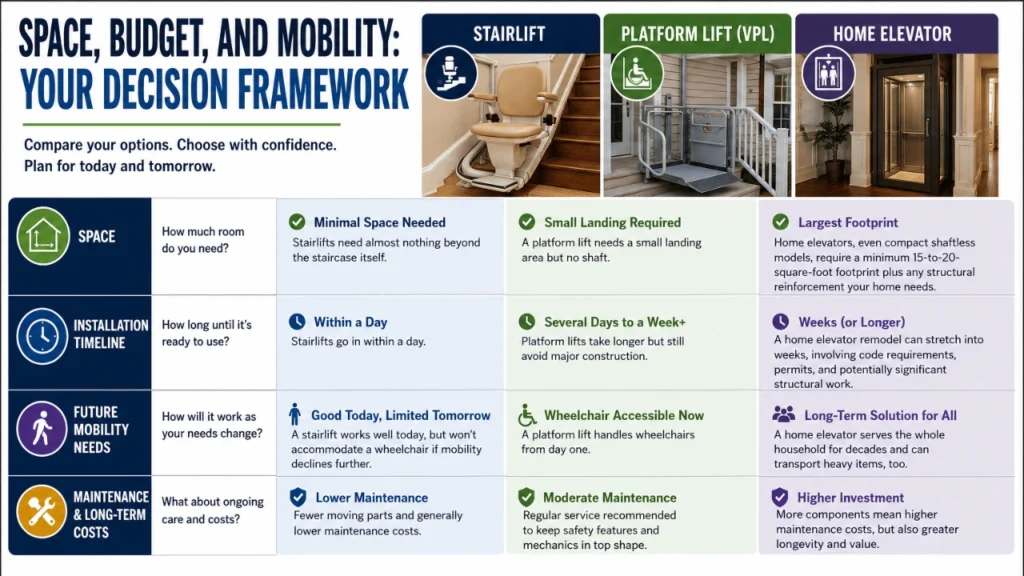
Space, Budget, and Mobility: Your Decision Framework
Before you request a single quote, get honest about four variables.
Space
Stairlifts need almost nothing beyond the staircase itself. A platform lift needs a small landing area but no shaft. Home elevators, even compact shaftless models, require a minimum 15-to-20-square-foot footprint plus any structural reinforcement your home needs. If your home is tight, start with a stairlift or VPL assessment before exploring elevator options.
Installation Timeline
Stairlifts go in within a day. Platform lifts take longer but still avoid major construction. A home elevator remodel can stretch into weeks, involving code requirements, permits, and potentially significant structural work. If someone in the home needs a solution now, that timeline matters.
Future Mobility Needs
This is the one most people skip. A stairlift works well today, but won’t accommodate a wheelchair if mobility declines further. A platform lift handles wheelchairs from day one. A home elevator serves the whole household for decades and can transport heavy items, too. Choosing with aging in place in mind means thinking past your current situation, not just solving today’s problem.
Maintenance and Long-Term Costs
Ask any installer about annual service contracts and replacement parts before signing. Safety features like seat belts, obstruction sensors, and battery backup vary across products and price points, so compare carefully.
Your Next Step: Finding the Right Fit for Your Home
A stairlift home elevator decision isn’t just about solving a problem today. The right mobility lift for the home is one that adapts as needs change, keeps everyone safe on the stairs, and doesn’t require another full remodel in five years. Whether that’s a chair lift installed tomorrow or a hydraulic elevator built to last three decades, the best option is the one that fits your home, your budget, and the life you’re planning to live in it.
At HomePRO Mobility, we help homeowners compare the best stairlifts Loganville, GA has to offer based on their staircase layout, mobility needs, and budget. Our team provides professional stairlift installation Georgia residents can trust, along with rentals and ongoing service support. If you’re searching for stairlifts for seniors near me, contact us today to schedule an in-home assessment and find the right accessibility solution for your home.
Frequently Asked Questions
Stairlift costs typically range between $2,000 and $10,000, including installation and maintenance, according to the NCOA. For a straight staircase with standard features, most installations land between $3,000 and $5,000. Curved stair lifts for seniors require custom tracks and cost more, as do outdoor models that need weatherproofing.
Platform lifts help wheelchair users and people with mobility challenges move safely between different levels of a home without using stairs. They can increase independence, improve accessibility, reduce physical strain on caregivers, and often require less space and structural modification than a traditional home elevator.
Shaftless elevators and pneumatic vacuum elevators are often the best choices for small spaces because they require minimal structural modifications and have a compact footprint. Some models can fit into unused corners or closets, while stairlifts and vertical platform lift installations require even less space and may be suitable when the room is extremely limited.
