
Navigating stairs can become difficult and unsafe for seniors and wheelchair users, especially in multi-level homes. That’s why many families consider mobility solutions like stair climbers & stairlifts for the home. While both help improve accessibility, they differ in cost, convenience, safety, and long-term usability. Choosing the right option depends on your mobility needs, home layout, and daily routine.
Understanding the Difference: Stair Lifts vs. Stair Climbers
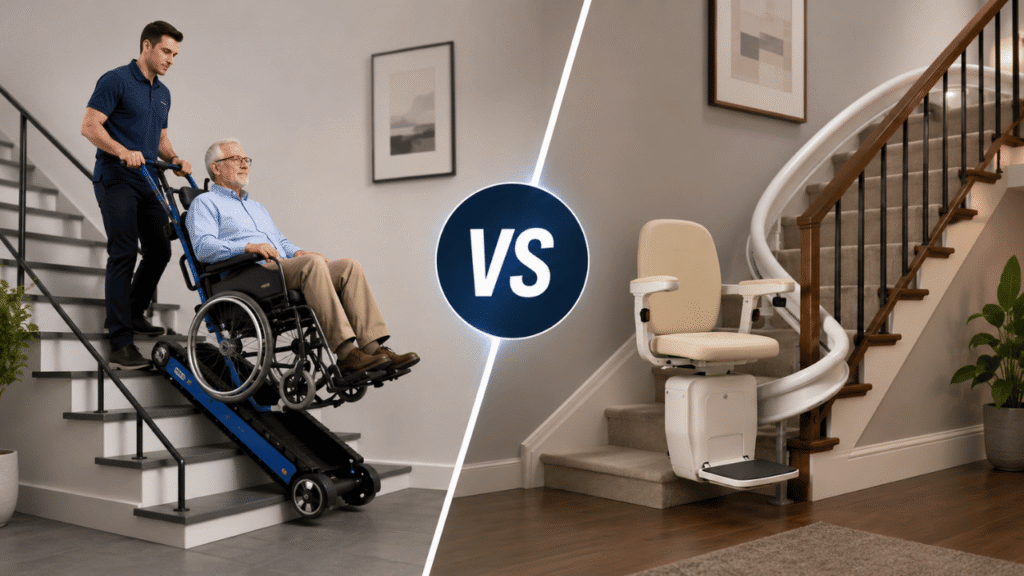
A stair lift is a motorized chair system attached directly to the staircase, designed to safely carry a person between floors. It is best suited for individuals who need dependable daily mobility support at home. Many families choose stairlifts for the elderly as they support independence and reduce strain on the knees and joints.
Stair climbers work differently. These portable devices help wheelchair users go up and down stairs with assistance from a caregiver or attendant. Since they are mobile and do not require permanent stairlift installation, stair climbers are often used in apartments, public spaces, and temporary accessibility situations.
In many homes, installing a lift or wheelchair ramp may not be practical due to limited space or structural restrictions. Stair climbers can also work well as an alternative to outdoor wheelchair ramps, especially for exterior steps and uneven entryways.
Pros and Cons of Portable Stair Climbers for Wheelchairs
Portable stair climbers are a practical option for wheelchair users who need temporary or on-the-go stair access without major home modifications. Some models are compact enough for travel and can work in places where wheelchair ramps, portable or permanent lifts are unavailable.
Pros
- No permanent installation required
- Easy to transport and store
- More affordable than permanent lift systems
- Useful for apartments, travel, and emergency situations
Cons
- Requires caregiver or attendant assistance
- Battery-powered and needs regular charging
- Less convenient for daily multi-floor use
- Some models can feel heavy or harder to maneuver on narrow or slippery stairs.
For occasional accessibility needs, stair climbers can be effective, but they may not offer the same comfort and independence as a stairlift in the home.
Pros and Cons of Stair Lifts for Long-Term Home Accessibility
For seniors and individuals with limited mobility, stair lifts provide a reliable way to move safely between floors without major home renovations. Many families prefer Stairlifts for the home because they support long-term independence and can usually be installed quickly by experienced accessibility professionals.
Pros
- Reduces the risk of stair-related falls.
- Supports independent daily movement at home.
- Quick installation with minimal structural changes.
- Available for both straight and curved staircases.
- Many modern models include backup batteries during power outages.
Cons
- Requires regular maintenance and battery checks.
- Stair rails may take up visible staircase space.
- Users must transfer from a wheelchair to the seat.
- Less suitable for people who become fully wheelchair-dependent over time.
Compared to major remodeling or adding a full wheelchair ramp for the home, stair lifts are often a more practical long-term accessibility solution for multi-level homes.
Cost Comparison: Stair Lifts vs. Stair Climbers
Both stair climbers & stair lifts can improve accessibility depending on the user’s mobility needs and home layout. In homes where outdoor wheelchair ramps are not practical, stair lifts and stair climbers may provide alternative ways to navigate stairs more safely and comfortably.
| Comparison Point | Stair Lifts | Stair Climbers |
| Home Modification | Requires rail installation on stairs | No home modification needed |
| Daily Use Suitability | Designed for regular daily use | Better for occasional use |
| Mobility Support | Allows more independent movement | Usually needs caregiver assistance |
| Storage | Remains attached to the staircase | Can be folded or transported |
| Long-Term Accessibility | Suitable for aging-in-place setups | Useful for travel or temporary access |
| Ongoing Care | Periodic servicing and battery checks | Mainly battery charging and basic upkeep |
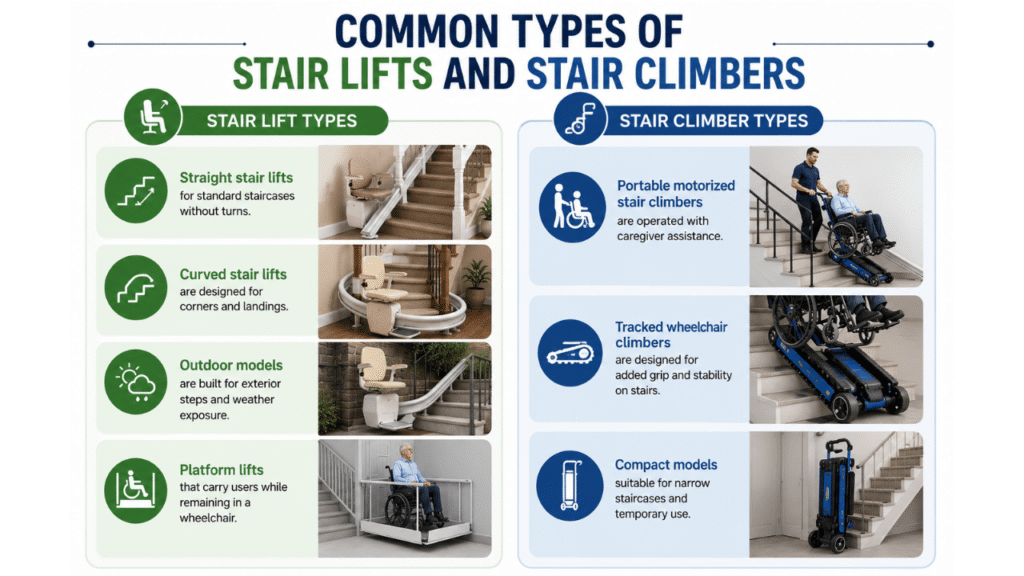
Common Types of Stair Lifts and Stair Climbers
Different staircase layouts and mobility needs may require different accessibility solutions.
Stair Lift Types
- Straight stair lifts for standard staircases without turns.
- Curved stair lifts are designed for corners and landings.
- Outdoor models are built for exterior steps and weather exposure.
- Platform lifts that carry users while remaining in a wheelchair.
Stair Climber Types
- Portable motorized stair climbers are operated with caregiver assistance.
- Tracked wheelchair climbers are designed for added grip and stability on stairs.
- Compact models suitable for narrow staircases and temporary use.
Safety and Installation: Choosing Which Is Better for Your Home
Safety and ease of use are two of the biggest factors when choosing between stair lifts and stair climbers. Stairlifts for the elderly are designed for independent daily use and typically include seat belts, swivel seats, safety sensors, and backup batteries. Professional stairlift installation also helps ensure the system fits securely to the staircase for reliable long-term use.
Stair climbers can also provide safe stair access, especially for wheelchair users, but they usually require caregiver assistance during operation. Since they are portable and do not need permanent installation, they are often preferred for temporary accessibility needs, travel, or homes where structural modifications are limited. The better option depends on the user’s mobility level, staircase design, and whether independent or assisted movement is needed.
Stair Climbers vs. Stair Lifts: Which Should You Choose?
The right mobility solution comes down to comfort, safety, and how much daily support the user needs. Stairlifts for the home are often the better option for seniors or individuals who want safe, independent movement between floors every day. Stair climbers are more practical for temporary accessibility, travel, or homes where permanent stairlift installation is not possible because of space or structural limitations.
At HomePRO Mobility, we help families improve safety and comfort at home with trusted mobility solutions tailored to their needs. Whether you need Stairlifts for home, portable ramps, or professional stairlift installation, our experienced team provides reliable accessibility solutions designed for your mobility needs. Our goal is to support long-term independence, safety, and everyday confidence at home.
Frequently Asked Questions
What Is the Cost of a Stair-Climbing Wheelchair?
The cost of a stair-climbing wheelchair depends on the model, weight capacity, battery system, and safety features. Portable stair climbers are generally more affordable than permanent stair lift systems, especially since they do not require installation.
Can Stair Climbers Be Used Without Assistance?
Most stair climbers are designed to be operated with assistance from a caregiver or attendant. They are not typically intended for fully independent use on stairs.
Do Stair Lifts Work During a Power Outage?
Yes, many modern stairlifts for the home include backup battery systems that allow the lift to continue operating during temporary power outages.
